


How to Ensure Your Emergency Fire Exit Door Meets Safety Standards
Your fire escape doors are not merely a piece of property but rather an essential part of the equipment for safeguarding lives. They are the ones to separate a smooth evacuation from a hazardous bottleneck during an emergency. And here’s the fact: Australian laws place the legal obligation directly on business owners, strata managers, and property managers to ensure those doors comply with the requirements for fire exit door safety. If not, you will face serious consequences, including fines, liability risks, and injuries to your employees or the occupants.
Australian Standards Overview
Fire exits in Australia must comply with several key regulations, but the two most relevant are the Building Code of Australia (BCA) and AS/NZS 1428.1, which covers accessible paths of travel. Don’t worry, you don’t need to memorise the codes. What matters is understanding the basics of emergency exit compliance in Australia and what inspectors look for.
Emergency exits must be easy to identify, unobstructed, accessible to everyone, and capable of being opened quickly without keys or tools. Any locks must allow free escape at all times; security requirements never override Australian Standards fire exit rules.
Different building types (commercial, industrial, and strata) have slightly different requirements, and regular maintenance is mandatory. Failing to meet fire safety compliance standards can result in significant penalties and legal exposure.
Common Fire Exit Door Requirements
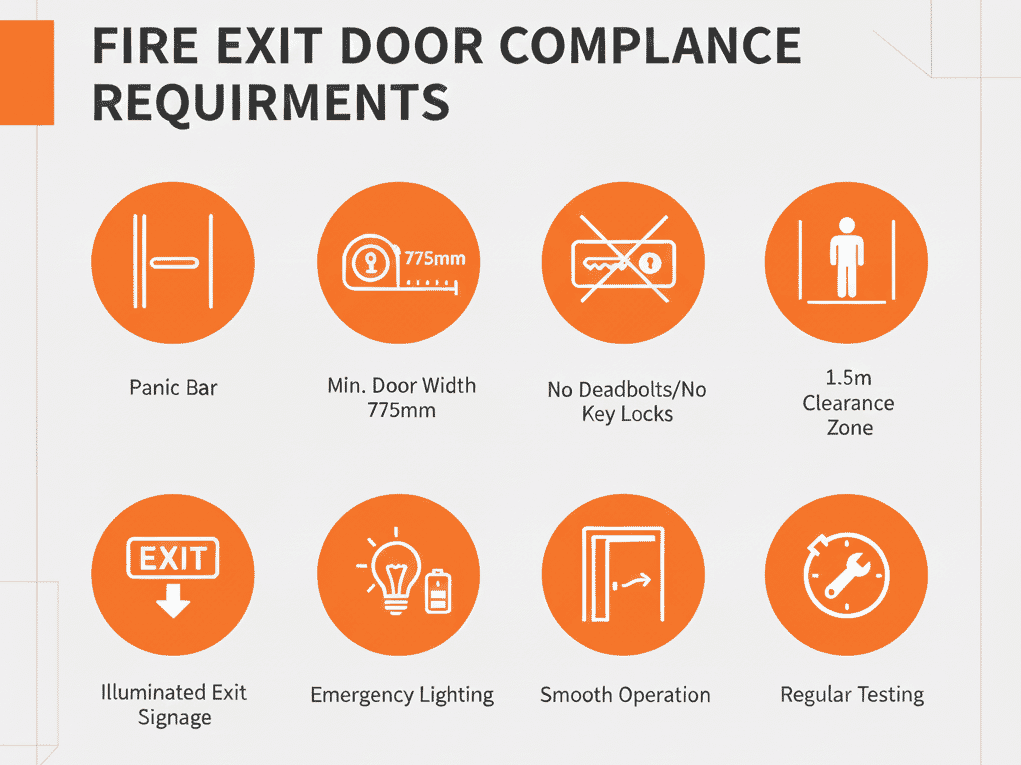
The following fire exit door regulations are the most vital ones for every business or strata property in Sydney to verify:
- Panic Bars: Must be able to open the door through the exertion of just one downward push at least.
- Minimum Door Width: To ensure safe fire exit, a compliant door must not be narrower than 775 mm.
- No Restrictive Locks: For these types of locks, such as a deadbolt, double-cylinder or any lock requiring a key, are not allowed unless they automatically open during emergencies.
- Unobstructed Clearance: There should be a 1.5m clear space on the side of the approach with no boxes, furniture, or equipment.
- Exit Signage: A “Emergency Exit” sign above the door that is visible
- Emergency Lighting: The main exit path must be illuminated during evacuation.
- Easy Operation: Doors should open with a standard mechanism and not require tools, keys, or special knowledge.
- Regular Testing: Push bars must be tested monthly, while complete exit door maintenance should be done quarterly.
- Safe Discharge: The exit shall be through to a secure outdoor area.
Inspection Checklist – What to Look For
You can quickly determine your current compliance status:
- Signage: Is a clear “Emergency Exit” sign set up in such a way that its location can be seen from a long distance? If it is lit, is it working well?
- Door’s Operation: Push the panic bar. Does the door open without any delay and smoothly?
- Egress Route: Is the fire egress route free of any hindrances such as boxes, furniture, or stock?
- Emergency Lighting: Take the route with the overhead lights off. Is the area still visible?
- Condition of the Hardware: Are the hinges free of rust? Is the door positioned correctly in its frame?
- Locking Device: Do all locks meet the standards? Panic-rated hardware only, no deadbolts or key-only exits.
- Door Face: Observe for any dents, warping, or damage that may prevent the door from closing properly.
- Paperwork: Have you kept a maintenance record? What was the date of the last inspection?
- Signage Visibility: Does the sign have the correct dimensions, and is it unobstructed?
- Flooring: Ensure the area around the exit has non-slip flooring.
A visual inspection helps, but only a licensed professional can ensure that life-safety standards and legal requirements are met.
Common Compliance Mistakes
Negligence is rarely, if ever, the cause of compliance issues; rather, it is the day-to-day errors that are overlooked and gradually accumulate. We have listed below the most common mistakes that we encounter during audits:
- Occupancy and furniture that obstruct fire exits, in particular, the areas at the back of the house.
- Use of worn-out or jammed panic bars.
- Locks not in compliance with regulations, for instance, deadbolts that need a key to exit.
- Exit signage that is not there or not lit.
- An emergency light that doesn’t function during a power outage.
- No maintenance records, which is a common strata compliance issue.
- Door hinges or tight frames make it difficult to open the door.
- Cluttered aisles, thus reducing the required egress width.
- Staff are not aware of the duties of fire wardens or emergency procedures.
Why Professional Inspection Is Essential
Even though your own visual examinations are pretty significant, the professional inspection guarantees that the premises are fully compliant with Australian Standards for fire exits. An experienced locksmith is well aware of the technical details of panic hardware, exit routes, fire doors, and locking mechanisms.
In addition, an expert inspection also hands over legal documents to you that serve as protection in case of audits or insurance claims. With regular maintenance contracts, you can maintain compliance year-round, eliminating the anxiety of last-minute fixes or fines.
Besides that, you will have access to a professional recommendation on hardware upgrades, from installing compliant panic bars to incorporating smart locks that preserve the emergency exit functionality, to improving signage and lighting.
Book your professional fire exit compliance inspection now.
Clockwork Locksmiths’ Role in Fire Exit Compliance
Clockwork Locksmiths are professionals that you can count on when it comes to fire safety in commercial premises. They are collaborating with businesses, strata with kids, and different kinds of establishments. Fire safety is one of the areas where Clockwork Locksmiths have excelled and are accepted by all professionals in the field.
First, they examine the hardware, identify components that are not up to standard, and finally provide the client with a practical fix. Their crew is ready to install the necessary equipment, such as exit hardware, panic bars, emergency signage, and lights.
Clockwork has excellent maintenance programs in place, offers 24/7 emergency support, and transparent reporting.
Compliance with your safety standards is our duty, and we take it seriously.
Don’t Risk Safety Get Your Fire Exit Checked Now
Don’t let a bad audit or an emergency catch you off guard with non-compliant fire exits. A straightforward inspection today can be the reason why fire and loss of money are not your problems tomorrow.
Contact Clockwork Locksmiths to get a no-obligation fire exit compliance assessment.
Our personnel can reach you anywhere in Sydney and are always on standby, 24/7, for urgent inspections or repairs.
Enjoy the peace of mind that comes from knowing your emergency exits are up to code, and have them professionally checked, serviced, and certified to protect you legally.